Reading a royalty statement: what every distributor file says, and DDEX DSR
DistroKid, TuneCore, Believe and the rest all send the same facts in different files. What the columns mean, the traps that make totals wrong, how stores report through DDEX DSR, and how Aden reads them.
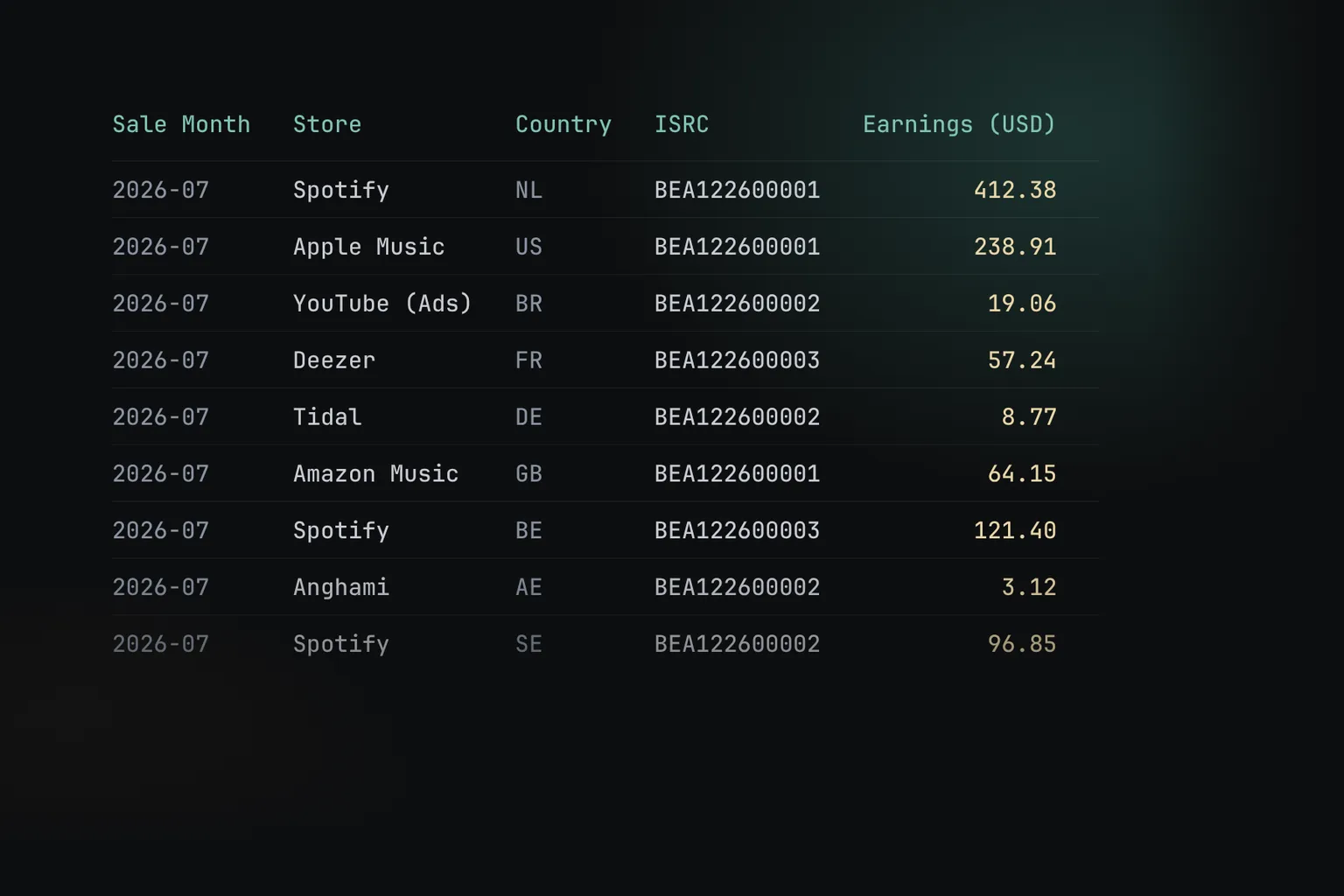
Every distributor pays you with a file. DistroKid sends a tab-separated report, Believe a CSV split by semicolons, LabelWorx an Excel sheet. They look nothing alike, but they answer the same questions: which recording earned, where, how, and how much.
Read one well and you can check every other. Read one badly and you pay an artist twice, or not at all.
What every statement says
Whatever the layout, each row is one slice of income. These are the facts you will find, under different names:
| Fact | What it means | Names you will see |
|---|---|---|
| Recording | Which master earned | ISRC, Isrc, ISRC Code |
| Release | Which product it was sold in | UPC, EAN, Barcode |
| Store | Who paid | Store, Platform, Partner Name, Service |
| Territory | Where the listener was | Country of Sale, Territory, Country/Region |
| Sale type | Stream, download, physical, sync | Sales Type, Transaction Type, item type |
| Units | Streams or sales | Quantity, Units, # Units Sold, Count |
| Amount | What you are paid for this row | Earnings, Net Revenue, Subtotal, Total Earned |
| Currency | The currency of that amount | Currency, or written in the header |
| Period | When the listening happened | Sale Month, Sales Period, Activity Period |
The ISRC is the column everything else hangs on. It is how a row finds its track, and through the track, the people who are owed. If you are unsure what it is, ISRC, ISWC, IPI and UPC covers it.
Why no two files look alike
Separators. "CSV" is a loose word. DistroKid's classic report and CD Baby's separate columns with tabs, Believe uses semicolons, and most others use commas. Open the wrong way and a whole row lands in one cell.
Dates. The same day is 2025-01-01, 01/01/2025, 1/1/2025 12:00:00 AM or January 2025. Believe writes the day first, CD Baby the month first. Guess wrong and January earnings become the first of eleven months.
Two dates per row. Most files carry the month the listening happened (sale month) and the month the money reached the distributor (reporting date), usually two or three months apart. Royalty periods are about the first one.
Currency in the header. DistroKid's amount column is called Earnings (USD), Symphonic's Royalty ($US). There is no currency column to read: the header is the currency.
Net or gross. Some files show what the store paid and what you keep after the distributor's cut. Others show only what you keep. Amuse, for example, has Amount before the split and Total after it.
Encoding. Older exports are not always UTF-8. A Bandcamp report can arrive as UTF-16, an older DistroKid one in Latin-1. Read it as UTF-8 and "Björk" turns into "Bj�rk", and her rows stop matching her tracks.
The traps that make totals wrong
- Summary rows. Some files end with totals, or carry a balance brought forward. Add them to the detail and you count the money twice.
- Overlapping files. A statement can come as several files where one repeats another in more detail, such as a separate YouTube breakdown. Import one of them, not both.
- Returns and voids. Refunded downloads and fraudulent streams come back as negative rows. They belong in the total.
- Mixed currencies. Never add euros to dollars. Convert at a stated rate, or keep them apart.
- Album sales. One album download is one sale of the release, not one sale of every track on it.
The quickest check is the one most people skip: compare the total you imported with the total printed on the statement.
Where the numbers come from: DDEX DSR
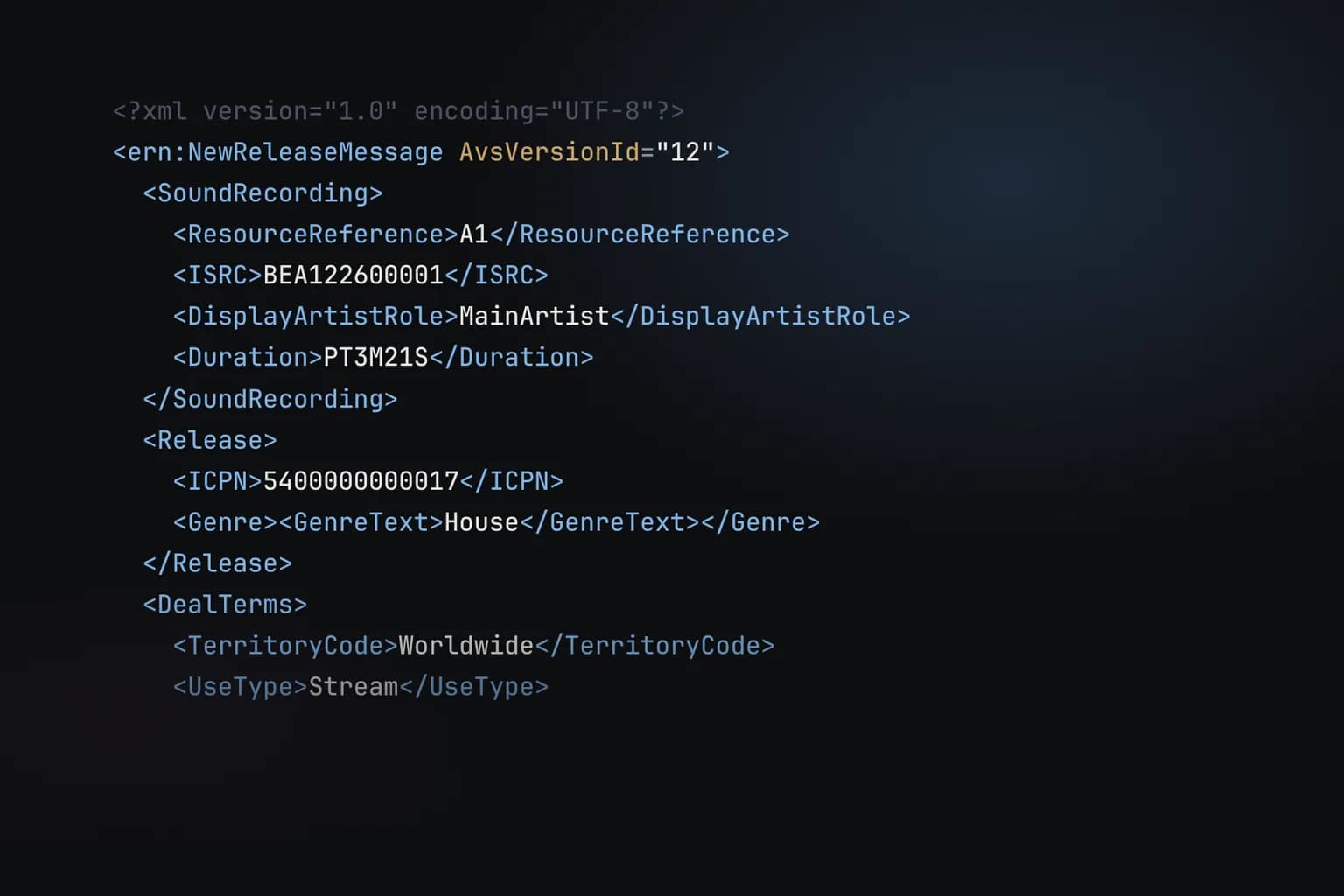
Your distributor's file is a digest. Underneath it, each store reports to the distributor in a DSR (Digital Sales Report), a DDEX standard the major stores use.
A DSR is a tab-separated file where each line starts with its record type. Summary records state the store's revenue for a territory, a service and a month, and how much of it belongs to this licensor. Release and resource records name the products and recordings by UPC and ISRC. Usage records count streams and downloads.
The part that surprises people: in the basic audio report, usage records carry counts but no money. A recording's amount is worked out from its share of the usage that a summary record covers. That is why a DSR cannot be summed row by row, and why distributors do that work before you ever see a statement.
DSRs go to the company that delivered the release to the store, with the matching ERN. Unless you deliver to stores yourself, you receive your distributor's statement, not the DSR.
How Aden reads statements
Built-in layouts. Import a statement from DistroKid, TuneCore, CD Baby, Believe, Symphonic, Amuse, Bandcamp, Revelator or LANDR and Aden recognises it from its columns. It maps each one the way that distributor documents it, with the right date format, currency and sale types, and says which one it recognised.
Any other file. Statements from anywhere else (LabelWorx, Qlero, AWAL, your own label's accounting) map once in the import wizard: pick which column is the ISRC, the amount, the store. Save the mapping as a template and next month's file imports in one step. Comma, tab and semicolon files, Excel, UTF-16 and Latin-1 all read.
Fix values on the way in. Rename a distributor's "Streaming" to a stream, strip text from a column, or multiply amounts reported in cents.
Check the total. Type the total printed on the statement and Aden tells you whether the import matches it before you commit.
Match to tracks. Every row is matched to a track by ISRC, then UPC, then title and artist. What does not match is grouped for you to assign once, and remembered.
Pay the artists. Labels group statements into royalty periods, calculate each artist's share from their deal, recoup advances and publish a statement to every artist team.
What Aden does not read yet: DSR files themselves, which only labels that deliver to stores directly receive.
FAQ
What is a DSR in music?
A Digital Sales Report: the DDEX standard stores use to report streams, downloads and revenue to labels and distributors. Each recording is identified by its ISRC and each release by its UPC.
Why is my statement two months behind?
Stores report a month's listening after it closes, and distributors pass it on after the store pays them. A sale month of January often appears on a statement dated March or April.
Why does my distributor's total differ from the sum of the rows?
Usually a summary row, a balance carried forward, a currency conversion or rounding. Compare the detail rows, without any total rows, against the printed total.
Can Aden import LabelWorx or Qlero statements?
Yes, through the import wizard: map the columns once and save the template. They are not recognised automatically yet, because their exports either have no published columns or let each label rename them.
Do I need DSR files to pay my artists?
No. Your distributor's statement carries the same recordings and amounts per store and country. That is what Aden imports and what artist statements are calculated from.
Which column should I use as the amount?
The one that says what you receive after the distributor's share, often called net, earnings, total or payable. Keep the gross column too if your artist deals are calculated on gross.
Less admin. More music.